
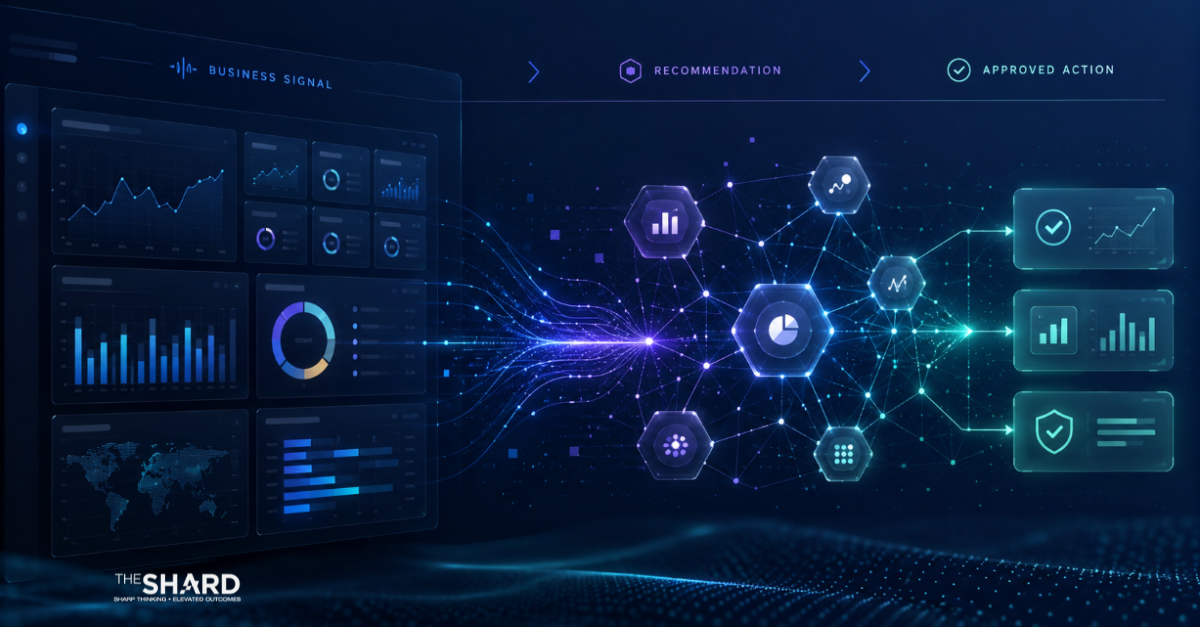
Executive mandates are shifting enterprise analytics from passive dashboards to proactive AI agents. This transformation focuses on automating actions and driving operational efficiency, rather than simply visualising past data. The goal is to shorten the time from a business signal to a trusted, automated action.
The established model of enterprise analytics, built on static dashboards and retrospective reporting, is becoming obsolete. We are moving into a new environment shaped by autonomous artificial intelligence agents designed to act on data directly. This shift demands a complete redesign of how businesses create commercial value from information, a change already visible in new board-level mandates and the strategic leadership appointments being made across the industry.
When major analytics players appoint new leadership, it signals a deeper strategic pivot, often foreshadowing significant shifts in product roadmaps and, crucially, how organisations will operate. The focus is no longer just on visualising what happened, but on automating what happens next.
The New Guard: Why Analytics Giants are Swapping Leadership
In their first 100 days, we’d expect new AI-centric leaders at firms to move from passive reporting to operational decision-making. The first step isn’t building more dashboards. It's auditing where decisions get stuck, which workflows are slowed by manual analysis, and where AI can safely reduce that friction.
We'd start by picking a few high-value, low-risk workflows and deploying small agentic interventions. These are agents designed to monitor signals, summarise evidence, recommend actions and route decisions for approval. Governance must be built in from the beginning, with human oversight, audit trails, feedback loops and active learning from corrections.
The strongest signal that this shift is working is simple. You start seeing fewer pretty dashboards for board packs and more workflows that actually make the business move.
Key Takeaway: New analytics leaders are being appointed with mandates to replace passive dashboards with automated, action-oriented workflows.
Beyond the Glass: The Decline of Passive Dashboard Culture
The biggest psychological hurdle for executives shifting away from dashboards is the loss of control. Dashboards feel safe. Many leaders come from a world of reports and static presentations, where the inputs and processes are predictable and easy to understand. Staring at a chart and asking a few questions in a meeting creates an illusion of command. The problem is that this comfort fostered a passive culture of observation. It answers ‘what happened’ but offers no clear pathway from signal to action.
This is where the agentic model fundamentally diverges. An agent offers a direct path from observation to delegation: "Here is the answer, here is the recommended action, and here is what should happen next." This transition, from observing to delegating, is the biggest psychological hurdle for many leaders. It represents a perceived loss of control. An introduction of uncertainty that traditional reporting didn't present.
To overcome this, we can't simply say, "Trust the AI." Agents must be transparent, auditable, reversible, and explicitly linked to the people who own the underlying workflows. Begin the process by automating the often-tedious tasks that no one enjoys. As people observe agents removing friction without replacing judgment, adoption will become a natural progression.
Key Takeaway: The primary barrier to adopting agentic AI is executive discomfort with delegating actions and losing the perceived control that dashboards provide.
Defining the Agentic Stack: Automation as the New Interface

What does an 'agentic stack' actually look like? It's not just a collection of AI tools. It's a fundamentally new operating model where data isn't only reported, but it actively drives and automates decisions.
Five years ago, a 'data-first CEO' might have been proficient in understanding dashboards, cloud infrastructure, and digital channels. Today, that's insufficient. A modern, data-first CEO recognises that data is integral to the business's operational model itself. They need to grasp the entire decision-making lifecycle: data provenance, reliability, underlying model assumptions, accountability for automated errors, and the velocity at which insight translates into action.
The real architectural shift is breaking down the wall between historical reporting and live operations. Most traditional business intelligence (BI) systems are designed to look backwards, displaying what has already happened. An agentic stack must connect directly to the operational tools your business actually runs on, like your CRM, communication APIs, and ERPs. Otherwise, you are just building an expensive chatbot on top of broken data pipelines.
The biggest inhibitors are the ingrained, messy data habits that companies tolerate. If your teams can't even agree on the basic definition of an 'active account' or 'revenue,' then deploying an autonomous agent will only automate that confusion on an unpredictable, massive scale.
Key Takeaway: An effective agentic stack is an entire operating model that requires clean data definitions and direct integration with business tools, not just a layer of AI.
The Financial Mandate: Why Efficiency Now Outweighs Insight
The executive mandate has shifted from insight to efficiency, driving tangible ROI through automation. This makes the move from a 'human-in-the-loop' to a 'human-on-the-loop' model a commercial necessity. Trying to replace human judgement with AI overnight is simply a recipe for creating an expensive mess. The correct transition empowers people to monitor, supervise, review exceptions, and set boundaries, rather than manually executing every step.
Begin with low-risk agentic workflows. An analytics agent, for example, could identify a risk pattern, articulate the supporting evidence, draft a proposed intervention, and then route it to the appropriate individual for final approval. The 'agent' here lives within the existing workflow, understanding the code, data, documentation, and business rules before gaining greater autonomy.
In the unpredictable world of AI and noisy data, trust isn't fostered by blindly accepting model outputs. Trust is built by recognising model uncertainty, knowing when to escalate, and understanding when to halt an operation. An agent's capacity to declare, "I am not confident enough to act here," can prevent millions in losses.
To clean this up, a CEO should ask three simple questions about every dashboard and data pipeline: What specific decision does this support? Who actually acts on the data? And what breaks if we shut it down completely? If nobody can provide a clear answer, it’s technical debt. It's time to retire the duplicate dashboards, standardise your definitions, and redirect those engineering resources towards building the reliable, integration-ready data APIs your business will need.
Key Takeaway: The executive mandate for AI is now focused on achieving measurable ROI through efficiency, moving from manual processes to supervised automation.
Architecting the Pivot: How LLMs are Swallowing the Middle Layer
The wide availability of Large Language Models like ChatGPT and Claude has positively changed how executives engage with data. These tools have let non-technical leaders participate more meaningfully in conversations that once felt limited to engineering and data teams. A CEO doesn't need to code in Python or understand transformer architecture. They can, however, now brainstorm technical options, pressure-test assumptions, and grasp complex trade-offs much faster than before.
Boardroom FOMO is absolutely real and it’s fuelling a dangerous rush toward adopting autonomous AI agents without verified performance gains. Boards across the globe are demanding AI strategies, preferably with words like ‘agentic’, ‘autonomous’, and ‘enterprise-grade’ stamped on the slide deck. The risk materialises when companies start treating probabilistic AI systems like deterministic software, purely to hit quarterly transformation targets.
Air Canada’s chatbot debacle is a sharp reminder of this risk. Its bot gave a customer incorrect refund advice, and a tribunal ruled the airline was accountable for the output [1]. You simply cannot delegate responsibility. Commonwealth Bank of Australia provides another cautionary tale. The bank tried to cut customer service roles after deploying an AI voice bot, only to reverse the decision and apologise when it found increased call volumes and a continued need for human agents [2].
This is an example of what can happen when the push for automation is more than a business is realistically ready for. Agents will undoubtedly make errors when governance is weak, data is messy, and leaders automate workflows that are broken rather than redesigning them entirely.
Key Takeaway: While LLMs make AI more accessible to leaders, boardroom FOMO can lead to failed projects when organisations misuse probabilistic AI for deterministic tasks.
The Future of the Analytics Pro: From Report Builder to Agent Orchestrator

The role of the analytics professional is shifting from report builder to something closer to a product manager. Too many BI teams function as report factories, producing impressive dashboards that ultimately fail to change business behaviour. An AI-centric team must operate differently, building operational tools that move the organisation from signal to action. This redefines the primary performance metric. The old goal was ‘time to insight’, how quickly we understand what's happening. The new goal should be ‘time from signal to trusted action’.
This encompasses the speed at which the business detects a signal, recommends the correct action, secures the necessary approval, executes the action, and learns from the subsequent outcome. The qualifier 'trusted' is critical. Speed without reliability is meaningless if every action requires intensive human verification.
ROI in this context must consider the agent's accuracy, the frequency of human intervention needed, and whether the action genuinely improves the business outcome. A practical permutation of this metric could combine elements like: Signal → recommendation → approval → execution → outcome feedback.
Ultimately, the most effective analytics stack will no longer be the one with the most visually appealing dashboards, but rather the one that enables the business to move swiftly, securely, and intelligently before opportunities vanish or risks escalate.
Key Takeaway: The key performance metric for analytics is shifting from "time to insight" to "time from signal to trusted action", prioritising reliable, automated execution over mere visualisation.
Conclusion
The transition from a dashboard-centric understanding of data to an agent-driven operational model is more than a technological shift. It's a change in organisational philosophy. This new era demands leadership that comprehends data, not as a retrospective reporting function, but as an integral component of the business's operating model.
The executive mandate has evolved, prioritising ROI through intelligent automation and efficient, trusted action. Leaders must foster a culture where agents augment human decision-making, where governance is robust, and where technical debt is ruthlessly pruned. The future of enterprise analytics is about creating dynamic, intelligence-driven workflows that propel businesses forward, safely and decisively.
Sources
Key Definitions
Agentic AI
An artificial intelligence system capable of autonomous, goal-oriented action. In an enterprise context, it automates workflows and makes decisions, moving beyond simple data reporting to actively executing tasks.
Analytics Stack
The integrated collection of technologies, tools, and processes an organisation uses to collect, analyse, and act upon data. A modern stack prioritises automated action over passive data visualisation.
Human-on-the-Loop
A system of governance where humans supervise automated AI agents. People manage exceptions, set boundaries, and review outcomes rather than manually performing every step of a process.
Data-First CEO
An executive leader who treats data as a core component of the business operating model, not just a reporting function. They focus on the entire decision lifecycle, from data origin to accountability for automated actions.
Time to Trusted Action
A key performance indicator for agentic analytics that measures the total time required to detect a business signal, recommend a correct action, secure approval, execute it, and record the outcome. It values reliability and speed of execution over simple insight.
Frequently Asked Questions
What is the main shift occurring in enterprise analytics?
The primary shift is from retrospective data visualisation on static dashboards to proactive, automated decision-making driven by autonomous AI agents. The focus is moving from reporting on the past to automating future actions.
Why are analytics firms appointing new leaders?
Analytics companies are bringing in new leadership to accelerate the strategic pivot from traditional business intelligence towards operational AI. These leaders are tasked with embedding automated workflows into the business, prioritising action over simple insight.
What is the biggest cultural barrier to adopting AI agents?
The greatest psychological hurdle for leaders is the perceived loss of control when transitioning from the familiar safety of dashboards to delegating decisions to AI agents. Building trust requires making agents transparent, auditable, and clearly governed.
What is an agentic stack?
An agentic stack is an operating model where data drives and automates business decisions. It requires direct integration with operational tools like CRMs and relies on clean, consistently defined data to function effectively, moving beyond just being a collection of reporting tools.
How should a CEO measure the return on investment (ROI) of agentic AI?
The new goal is "time from signal to trusted action". This measures the speed and reliability of the entire process: from detecting a business signal to recommending, approving, executing an action, and learning from the result.
What are the risks of rushing the adoption of agentic AI?
A significant risk, often driven by boardroom FOMO (Fear Of Missing Out), is treating probabilistic AI like deterministic software. This approach fails when automation is applied to messy data or broken workflows, leading to operational failures and reputational damage.
What is the difference between 'human-in-the-loop' and 'human-on-the-loop'?
'Human-in-the-loop' describes a process where a person must manually execute each step. In a 'human-on-the-loop' model, AI agents handle the automated workflow while humans supervise, manage exceptions, and provide governance.
Keywords: AI Analytics, Agentic AI, Data-First CEO, Executive Leadership, Analytics Stack, Business Intelligence, Digital Transformation