

Traditional actuarial models are failing because they rely on historical data that cannot keep pace with today's non-stationary climate, leading to systematically underpriced risk. Actuaries must adopt real-time machine learning to analyse live data streams, accurately price risk, and move from a reactive to a proactive stance on climate volatility.
In April 2022, KwaZulu-Natal was hit by floods that insurers hadn’t adequately priced for. The result was a multibillion-rand claims bill and an industry that swung from a profit in 2021 to a loss in 2022. That’s what happens when actuarial models built on historical averages meet a climate that no longer behaves like its own history.
This isn’t just a one-off event. As extreme weather becomes more frequent, more severe and less predictable, insurers relying on backward-looking data are carrying risk they haven’t adequately priced, and don’t yet know they’re carrying. The industry may therefore be systematically underpricing climate risk. This article looks at why traditional models are falling short, what the KZN floods revealed, and how real-time data and machine learning can close the gap.
The End of the Historical Proxy
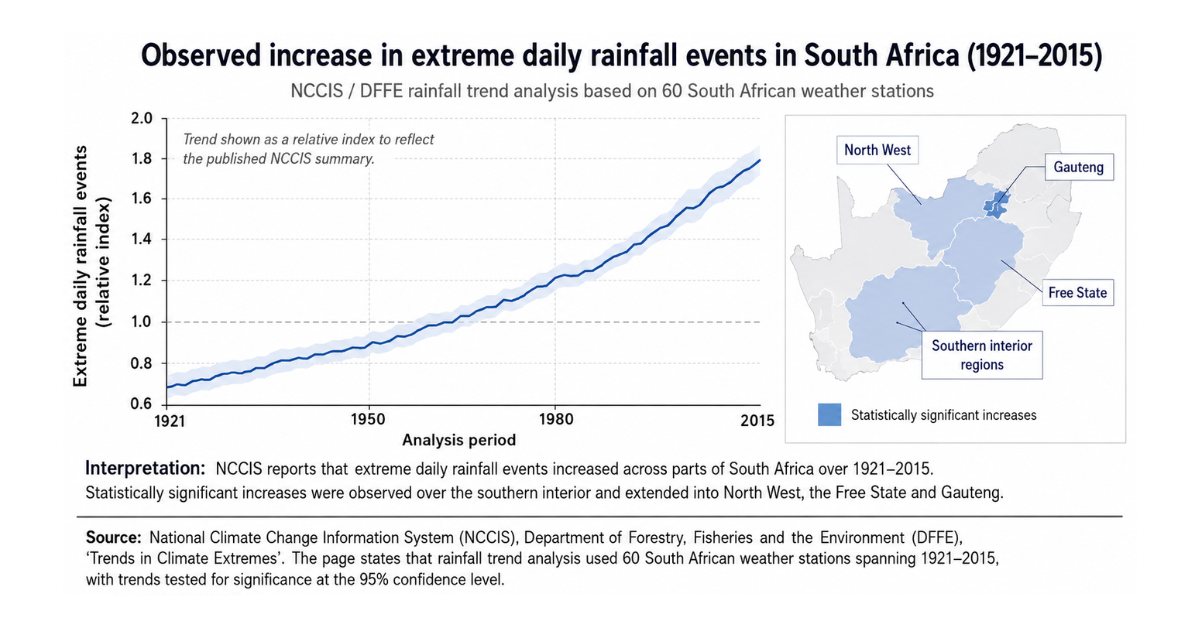
For decades, the actuarial profession has relied on historical datasets built on the principle of stationarity. This assumes that while patterns might fluctuate, they remain relatively stable over time. That assumption is now obsolete. Climate is a non-stationary system defined by increasing unpredictability and a clear trend towards more frequent, severe weather. Relying on long-term historical averages to price risk today fails to account for the current trajectory of environmental change.
Before getting to the failure point, it is useful to be clear about what is being modelled. In general insurance, climate risk is often assessed through catastrophe models that combine hazard data, insured exposure, vulnerability assumptions and loss calculations. In life and pensions, the link is usually less direct, feeding into mortality, morbidity, longevity, asset values and capital scenarios. These tools are not crude. The weakness is that many still rely on historical experience, fixed assumptions or periodic updates. When the climate signal is moving faster than the model cycle, even a technically sound model can fall behind the risk.
These traditional datasets are failing in several critical ways. The most significant blind spot is the gross underestimation of tail risk. Averages smooth out extremes, yet it is precisely these high-consequence events that now pose the greatest threat. The April 2022 KwaZulu-Natal floods illustrate the problem. World Weather Attribution estimated that the two-day rainfall event had a return period of about 20 years in today’s climate, compared with about 40 years in a 1.2°C cooler world. This means that climate change has already made an event of that magnitude roughly twice as likely. [2]
At individual stations, the rainfall was more extreme, with Mount Edgecombe estimated at around a 1-in-200-year event. A separate flood chronology covering KwaZulu-Natal from 1836 to 2022 also suggests (within the limits of the available data) that Durban’s flood frequency has likely doubled over the last century. Historical labels such as “1-in-100-year” can therefore give a false sense of stability when the underlying climate system is shifting. [3]
Also, these models assume that past climate variability remains a reliable guide to the future. This was a reasonable approach when change was gradual, but the past is no longer a dependable predictor of future rainfall, storm intensity, or heatwave duration. Many datasets also suffer from a lack of long-term records for extreme events, leaving actuaries without centuries of flood or wildfire history to draw from. Building risk models on such a depleted foundation compromises the core duty to ensure financial stability and solvency.
Key Takeaway: Relying on historical data is failing because the assumption of a stable climate is obsolete, leading to a dangerous underestimation of extreme weather events.
When Outdated Data Distorts Risk
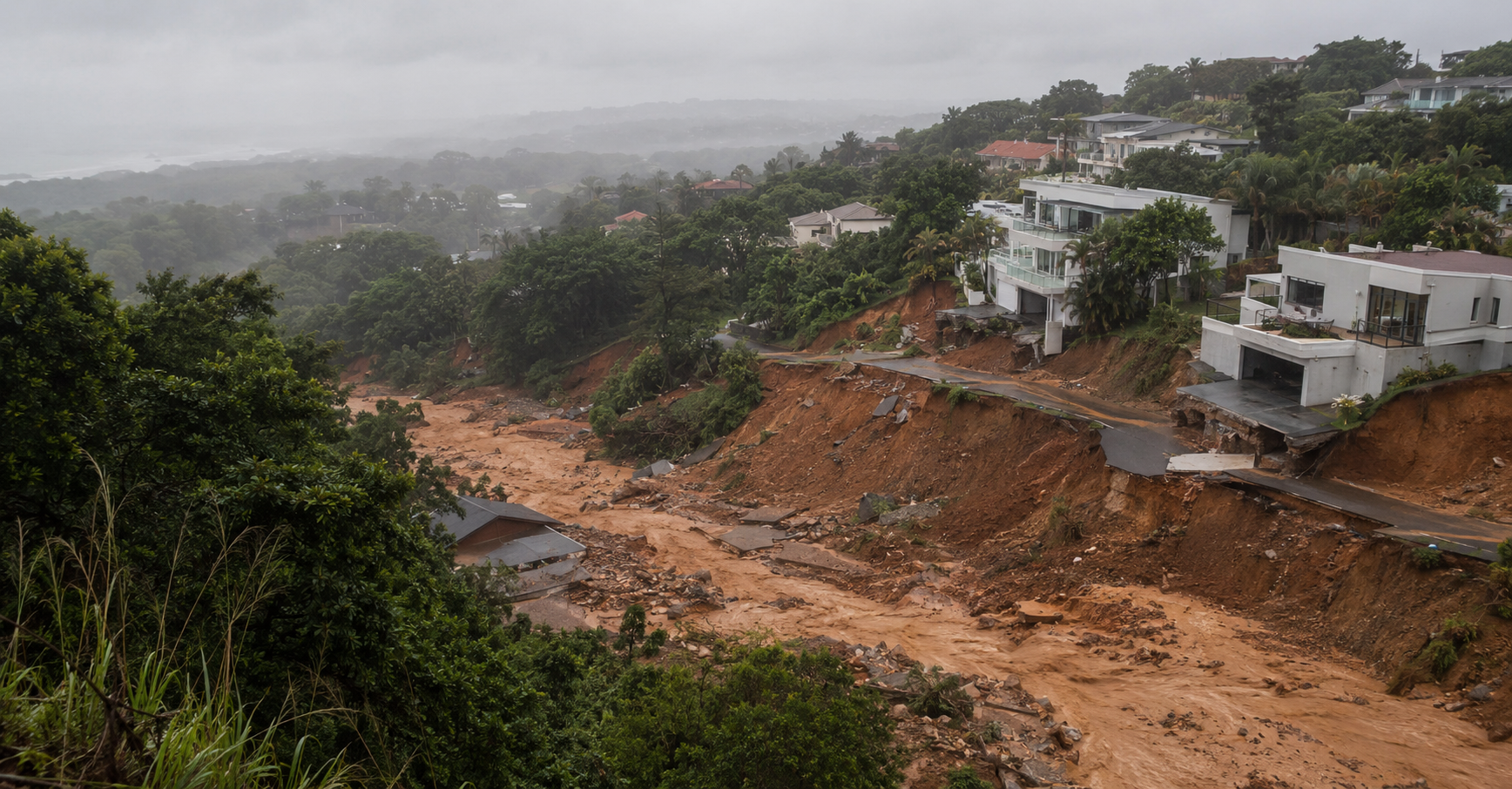
The April 2022 KwaZulu-Natal floods exposed a critical flaw in traditional actuarial modelling. These models are built on the assumption that past weather patterns will continue, but they failed to account for a disaster of this scale. In just 24 hours, significant rainfall caused landslides and infrastructure collapse. The event claimed about 448 lives. [1]
The impact on the insurance impact was severe. Claims exceeded R27 billion across the sector, with Santam itself paying approximately R4.3 billion of that. In hindsight, the pricing problem was obvious. Premiums had been set largely off historical experience, which no longer reflected the level of risk sitting in the portfolio.
The models failed because the event’s complexity overwhelmed them. Traditional models may have a significant blind spot in capturing how changing relationships between risks can affect the frequency, severity and interaction of losses, or the compounding effects of multiple, simultaneous hazards. In KwaZulu-Natal, the destruction resulted from flooding, landslides, and infrastructure failure all happening at once, which amplified the total loss far beyond what any static spreadsheet could predict. The industry’s heavy reliance on reinsurance to cover these claims points to potential limitations in current primary underwriting models. And while this crisis played out in South Africa, these same systemic weaknesses underpin portfolios across the UK and Europe today.
Key Takeaway: The 2022 KwaZulu-Natal floods exposed how using historical data led to radically underpriced premiums and devastating financial losses for the insurance industry.
Why Actuarial Models Need Feedback Loops
The April 2022 KwaZulu-Natal floods highlighted the challenges traditional actuarial models face in a changing risk environment. Although catastrophe models can account for interactions between risks, the relationships between hazards, as well as their frequency and severity, are not necessarily stable over time. This can make it difficult for models based heavily on historical relationships to fully capture how climate-related risks interact and potentially amplify losses.
A heatwave increases temperatures, dries out vegetation, raises wildfire risk, and creates the conditions for secondary impacts. Smoke affects air quality and can drive higher respiratory admissions, while the fires themselves weaken soil structure and remove natural cover. If heavy rainfall follows, the same area can then face a much higher landslide risk. The loss is not simply the sum of each event. The sequence changes the exposure. That is where older datasets struggle: they tend to treat hazards as separate events and lean too heavily on historical averages, which are poor at capturing how often these compounded events are now occurring and how quickly they can overwhelm a region.
Traditional actuarial tables, which underpin insurance pricing and pension planning, are ill-equipped to price these large-scale, intertwined impacts. Conventional mortality and morbidity assumptions are also becoming inadequate as they overlook health risks directly tied to climate change, such as heat-related illnesses and the migration of vector-borne diseases into new territories. By treating these threats as separate and linear, firms systematically underestimate the cumulative losses across their portfolios.
Key Takeaway: Actuarial models have a blind spot as they fail to account for how interconnected climate hazards create feedback loops, leading to compounded, non-linear losses.
From Batch Processing to Real-Time Intelligence
Refining existing frameworks may not be sufficient on its own. The opportunity lies in complementing established governance and oversight with continuous, data-driven risk monitoring. Traditional models often run quarterly or annually, meaning pricing and reserve decisions may rely on data that is already months old. While validation, committee oversight and regulatory review remain essential, providing these decision-makers with more timely and relevant risk information could support better-informed decisions and enable out-of-cycle intervention when emerging risks require it.
This creates a need to improve the quantity, quality and timeliness of information available to actuaries, boards and regulators. The growing availability of data, from satellite rainfall imagery and wildfire activity to financial markets, provides new opportunities to do so. Machine learning can analyse these increasingly diverse data sources to identify emerging patterns and provide more timely risk insights. Rather than replacing established review cycles, these insights could support more frequent monitoring, earlier scenario testing and targeted interventions, while allowing premiums, reserves and capital assessments to remain subject to appropriate governance and review.
This shift transforms the actuary's role from updating spreadsheets and recalibrating models to interpreting live risk signals and communicating emerging risks. By moving beyond post-event analysis, actuaries can manage the immediate volatility of the current environment. Machine learning acts as an enhancement to actuarial expertise rather than a replacement, empowering the profession to focus on interpreting volatility and guiding strategic decisions in real time.
Key Takeaway: The industry must transition from slow, periodic model updates to real-time machine learning that analyses live data and enables a rapid response to emerging risks.
Breaking the Culture of Averages and the "Black Box" Myth

The main barrier for insurers is not the modelling capability itself, but whether the business trusts the output enough to act on it. That hesitation is not irrational. Real-time models need clear explainability, strong controls over streaming data, and governance that most legacy actuarial environments were not built to support. Actuarial practice has also relied, for good reason, on the stability of long-run averages. The problem is that climate risk is becoming less stationary. In that context, historical stability can give a false sense of comfort and leave insurers exposed to solvency shocks that are not visible soon enough.
The 'black box' nature of machine learning remains a primary concern for regulators and boards who demand transparency. This is solvable through explainable AI (XAI) and layered communication frameworks that make complex models auditable without oversimplifying them. Instead of an opaque algorithm, actuaries should use models that generate feature importance scores to show exactly which variables, such as regional rainfall indices or wildfire fuel loads, drove a premium change.
Success depends on translating mathematics into a clear storyline. Customers need a narrative they can grasp, such as understanding that a premium rose by 12% because satellite data confirms that flood frequency in their specific zone has doubled over the last five years. By maintaining audit trails and creating tiered dashboards, actuaries can provide full technical outputs for internal teams, compliance summaries for regulators, and direct explanations for customers. The objective is to ensure that every risk signal is both auditable and understandable.
Key Takeaway: The primary barrier to adopting AI is cultural distrust, but this can be overcome with explainable AI (XAI) that makes complex model outputs transparent and auditable.
The Actuary’s Evolving Role in a Volatile World
The traditional actuary is not facing extinction, but the role is undergoing an integral and necessary transformation. Within a decade, the profession will look less like a group of custodians overseeing static tables and more like a collective of hybrid risk scientists. The new standard will be defined by specialists who are fluent in both core actuarial principles and real-time data science.
Foundational skills remain indispensable. Boards, regulators, and customers still require actuaries to interpret risk, ensure solvency, and translate complex models into coherent narratives. The actuary’s ethical standing as a 'trust anchor' for the financial system, ensuring fairness in pricing and reserving, is more vital in an automated age. The profession remains responsible for providing the long-term perspective, balancing short-term volatility with sustainable capital planning.
The day-to-day work will also change. Actuaries will spend less time producing periodic reports and more time working with live risk signals across climate, health and financial data. That does not replace the core actuarial skill set, but it does broaden it. Python, R and machine learning literacy will sit alongside the traditional technical training. The work will also become more multidisciplinary, with actuaries working more closely with AI engineers, climatologists and data scientists. The shift is from analysing historical averages in isolation to making sense of current volatility as it develops. Used properly, these tools can strengthen the actuary’s role as a risk interpreter in a less predictable environment.
Key Takeaway: The future actuary will be a hybrid risk scientist who combines core principles with data science skills to interpret live volatility rather than just guarding historical averages.
Conclusion
The financial consequences of inaction are surfacing, and the evidence is overwhelming. Relying on outdated historical models to price climate risk has moved beyond an imprudent strategy to a reckless gamble with shareholder capital and balance sheet stability. This systemic lag between data collection, model updates, and premium adjustments creates massive, unpriced liabilities across the industry. Effective risk management is impossible when the primary tools for measurement are fundamentally broken.
The shift to real-time, machine-learning-driven modelling is not a distant prospect. The technology is available today, and the frameworks exist to implement it in a way that remains transparent, auditable, and compliant. The AI trust barrier remains the most significant hurdle. Institutional inertia and a cultural demand for explainability prevent firms from integrating the streaming data sources that traditional actuarial systems struggle to handle.
Insurers must move their focus from the static averages of the past to the volatility of the present. This requires auditing current risk frameworks and beginning the work of integrating real-time data streams. Financial stability in a warming world depends on this transition. The actuary's role must evolve from updating spreadsheets and recalibrating models to interpreting live risk signals. By becoming hybrid risk scientists, actuaries move beyond backward-looking analysis to manage today's rapidly changing risk landscape.
Sources
Key Definitions
Non-Stationary System
A system, such as the contemporary climate, in which statistical properties like averages and volatility change over time. This makes historical data an unreliable predictor of future events.
Tail Risk
The risk of a rare but catastrophic event occurring that has a much larger impact than a typical event. Tail risks are often underestimated by risk models that rely on historical averages.
Explainable AI (XAI)
A field of artificial intelligence that provides tools and methods to help human users understand the results and outputs of machine learning models. XAI helps to solve the 'black box' problem, making AI auditable and trustworthy.
Feedback Loop (Climate Risk)
A cycle in which different climate hazards, such as a heatwave creating dry conditions for a wildfire, amplify one another. This creates a compounding effect that leads to greater overall damage than if each event occurred in isolation.
Frequently Asked Questions
Why traditional climate risk models for insurance need to be optimised?
Traditional models are based on historical data, assuming a stable or 'stationary' climate. With the climate becoming more volatile and extreme weather events more frequent, these models underestimate the probability and cost of catastrophic events, known as tail risk.
How did the 2022 KwaZulu-Natal floods demonstrate this model failure?
The KZN floods caused an estimated R54 billion in economic damage, with R27 billion in insurance claims. Traditional models, based on historical rainfall, did not adequately predict an event of this magnitude, leading to under-reserving. This single event shifted the entire South African non-life insurance industry from a R13.1 billion profit in 2021 to a R16.4 billion loss in 2022.
How does real-time machine learning change the daily work of an actuary?
Instead of running static models on a quarterly basis, actuaries can use machine learning to continuously analyse live data streams like satellite imagery and financial movements. This transforms their role from updating spreadsheets to interpreting live risk signals and communicating emerging threats, allowing them to manage volatility in real time.
Is machine learning too much of a 'black box' for a regulated industry like insurance?
This is a primary concern, but it is solvable with 'explainable AI' (XAI). Using models that generate feature importance scores, an actuary can show precisely which variables, like changes in rainfall patterns or wildfire risk, led to a specific premium adjustment. This ensures the process is both auditable for regulators and understandable for customers.
Will machine learning make actuaries redundant?
No, the role will evolve. The actuary will become less of a custodian of historical tables and more of a 'hybrid risk scientist' who combines core actuarial judgment with data science skills. Foundational skills like ensuring solvency, interpreting risk, and providing long-term perspective will remain critical.
What happens if insurers are slow to adopt AI-driven risk modelling?
If the industry fails to adapt, 'uninsurability' will become a reality for certain regions and sectors. In high-risk areas, premiums could skyrocket to unaffordable levels, or insurers may withdraw coverage entirely. This can have severe economic consequences, including collapsing property markets and increased reliance on government for disaster relief.
Keywords: Climate Risk, Actuarial Science, Machine Learning, Insurance, Risk Management, Insurtech